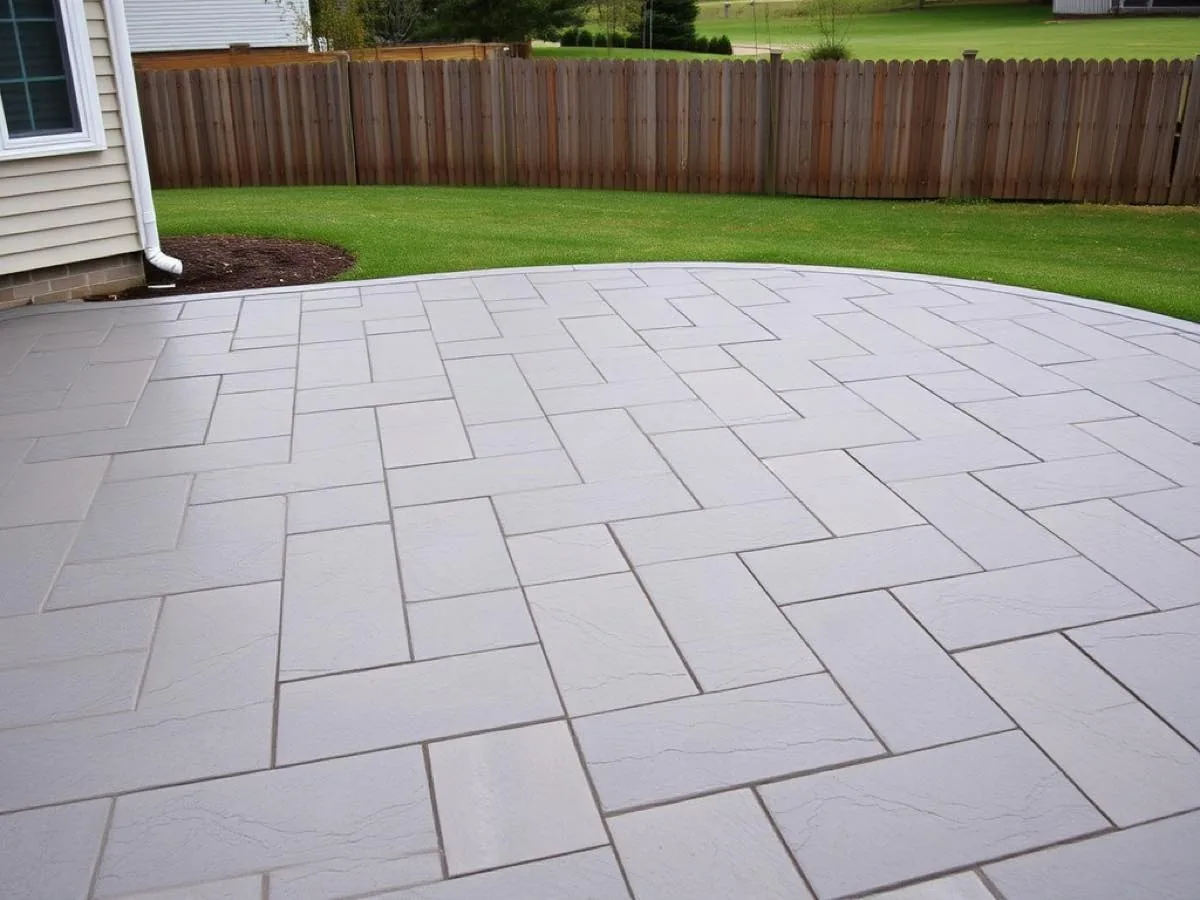
What concrete patios means in Las Vegas
Four inches over a compacted base is plenty for a patio. What matters more is that it sits below the house's damp course and slopes away from the wall, because a patio that ponds against a foundation is a problem that costs more than the patio did.
It is also the slab people look at most closely, from a seated height, which is why the finish and the joint layout matter here in a way they do not on a driveway.
Most valley back yards were built between 1990 and 2009 with a small builder-grade slab, and the common job here is extending it rather than pouring a first patio.
- Thickness
- 4 inches over 4–6 inches of compacted crushed stone
- Mix
- 3,500 psi, air-entrained, over a properly compacted native subgrade subgrade
- Ready to use
- walk on it after 3 days, furniture after 7, sealer at 28
- Typical cost
- $8-$15 per square foot for a broom finish, $13-$22 stamped
- Service life
- 25–30 years with joints maintained
How concrete patios is poured
The perimeter is set out first with the fall marked on the forms, a minimum of an eighth of an inch per foot away from the building and more where the ground allows.
Where the patio abuts the house it gets an isolation joint with a compressible filler, never a rigid bond. The house and the slab move differently and something has to give.
Control joints are laid out as part of the design rather than as an afterthought, on a grid of roughly square panels. On a patio they can be tooled into the pattern so they read as part of the layout instead of as a scar.
Curing is where a patio is won or lost. A slab that dries too fast at the surface ends up with a weak dusty skin, and on a decorative finish that also means the colour goes patchy.
What concrete patios costs in Las Vegas, NV
Broom finish is the baseline. Stamping, staining, exposed aggregate and a border in a second colour each add a per-foot amount, and a small patio carries the same setup cost as a large one so the per-foot rate is higher.
Patios run $8-$15 per square foot broom-finished and $13-$22 per square foot stamped, with shade structure footings set before the pour rather than drilled afterwards.
Where concrete patios goes wrong in Nevada
The failure that costs the most is a patio poured level against a house wall. It looks fine until the first heavy rain, and then the water has nowhere to go except into the wall.
Extending an existing slab in Las Vegas gives you two slabs poured twenty years apart. They will not match in colour, and the joint between them is permanent, which is why matching the whole area with a coating or overlay is often the better answer.
Where we do concrete patios
We cover Las Vegas, Henderson, North Las Vegas and the wider Clark County valley, including and 34 more areas.
Questions we get asked about concrete patios
How thick does a patio need to be?
Four inches over a compacted base. Thicker only matters if a vehicle will ever be on it.
How much slope?
At least an eighth of an inch per foot away from the house. A quarter is better where the ground allows it.
Can a patio be poured against the house?
It can abut the house with an isolation joint, and it has to sit below the damp course and slope away. Never bonded rigidly to the wall.
Get a free estimate
Tell us what you need. We answer the same day, the free estimate is on site, and nobody chases you afterwards.
Get a price for your concrete patios
Call (702) 966-9498 and we will come out, measure, and leave you a written quote. There is no charge for the visit and no obligation afterwards.